What's In A Name? Midwest SectionAll photos from the Krambles-Peterson Archive
Text by Art Peterson |
|
|---|---|
Use of distinctive names to identify the premiere train(s) on a route did not come into practice until nearly two decades after passenger trains first began operating in the US. The 1847 naming of the "Fall River Boat Train" is credited with beginning this practice, which reached its zenith around the time of World War One. As Bill Kratville noted in his superb book "Steam, Steel and Limiteds" these train names would become "household words." Thanks to the publicity skills of George Henry Daniels (and others), names like the "20th Century Limited" immediately suggested the notion of luxury, fine dining and the scenery of the water level route. The same was true of the many other fine named trains of the era. Even into 1950, the US still boasted some 350 name trains in operation. This series celebrates those once-familiar name trains on a regional basis. Each installment includes five trains, with the photos presented in chronological order. Since this feature is appearing on "The Diesel Shop" site, it also includes a variety of the diesels that were once in command of the name trains. Apologies if your favorite road/limited/locomotive model isn't included in this series. |
|
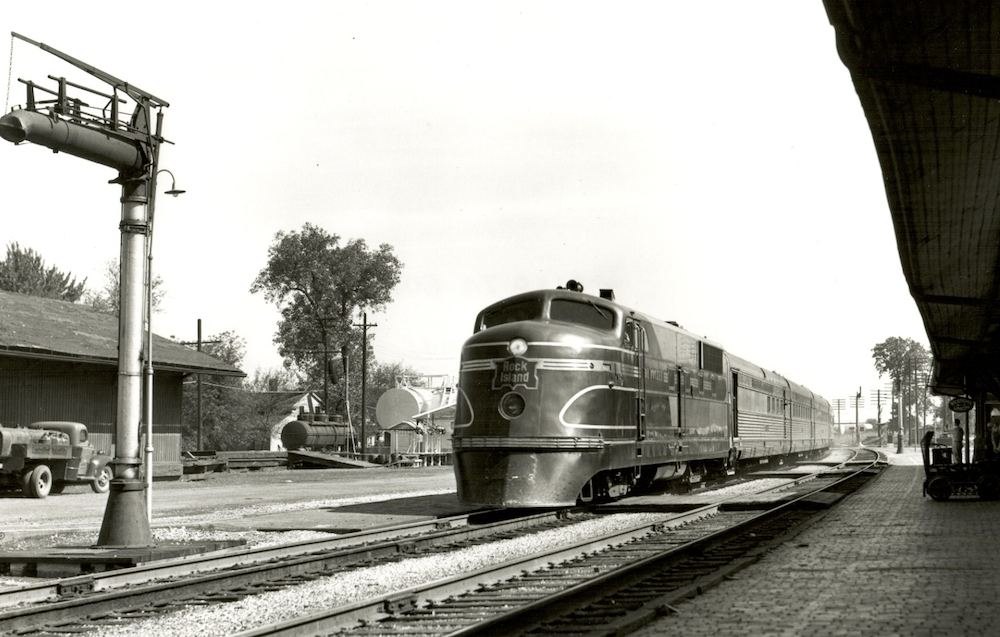
CRI&P TA 601 "Peoria Rocket" - WB Morris, IL - September 19, 1941 - AW Johnson Photo
The Grand-Daddy of the TAs, number 601, has the morning WB "Peoria Rocket" (Train 501) in
tow past the Morris, IL depot. The Rock began operating to/from Morris, 62 miles from Chicago,
on January 5, 1853. Morris was not a scheduled stop for these "Rockets" - they ran non-stop
from Joliet to Ottawa, 27 miles west of Morris.
An article in the premiere issue of "Trains" (November 1940) noted the 601 had accumulated
125,000 miles without requiring the removal of any moving parts of the Winton 201A 16-cylinder
prime mover. These custom-built/designed locomotives were a beautiful complement to the
articulated Budd-built consists that equipped the original "Rockets." Each of the two daily
round-trips of the "Peoria Rocket" provided coach, coach-dinette and parlor-lounge accommodations.
Rock retired the 601 in December 1957. The locomotive was scrapped at the Silvis Shops in
April 1960.
|
|
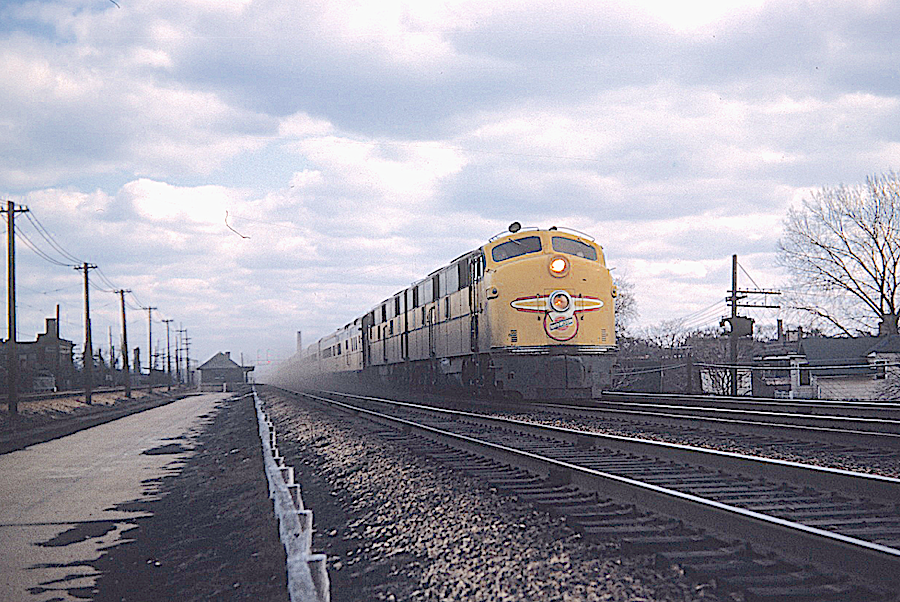
C&NW E7 5016A "Twin Cities 400"- NB Evanston, IL - April 22, 1951 -HM Stange Photo
Allotted just 12 minutes to cover the 12.1 miles to its first stop at Central Street,
Evanston, it's no surprise that the "Twin Cities 400" is stirring up a healthy cloud of dust
as it roars past C&NW"s Main Street depot. Not long after this photo was taken, the speed
survey in "Trains" noted that the train was required to cover the 49.9 miles from Evanston
to Racine in just 39 minutes, working out to an average speed of 76.8 mph.
From its initial streamlining in September 1939, the Northwestern spent lavishly to ensure the
"400" fleet had the latest in modern passenger equipment. Addiitonal, coaches, diners and
parlors were added in 1941, followed by more coaches in 1946 (the first new cars to go to a
western road post-War) and in 1947 (along with additional parlors). The year 1950 saw another
diner, along with baggage-café-lounge cars, added to the pool of cars available to meet passenger
demand.
Alongside the passenger car orders, C&NW continued to improve its motive power. E7 5016A was
built in September 1947. This locomotive remained active on the Northwestern after the "Twin
City 400's" last run on July 23, 1963. Retired in September 1971, it was sold for scrap the
following month.
|
|
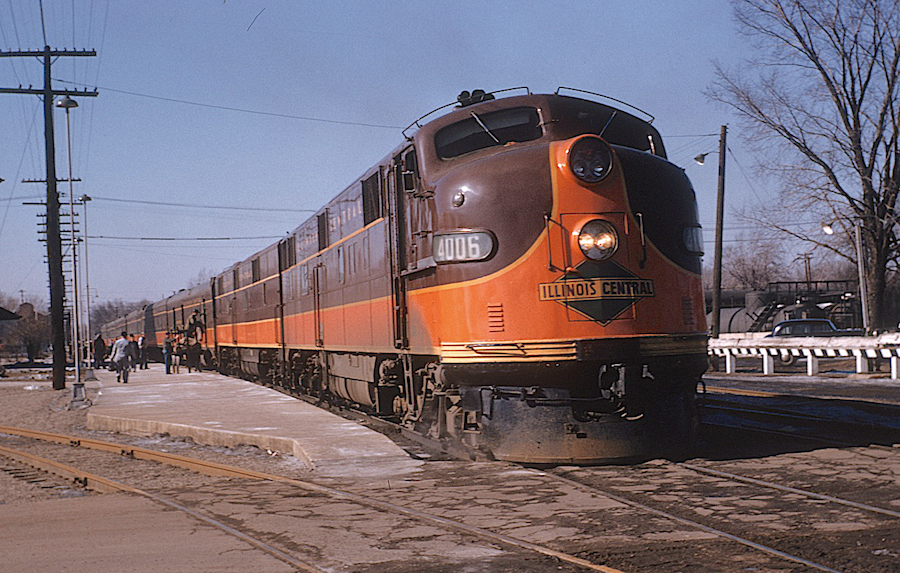
IC E7 4006 "Green Diamond" - NB Clinton, IL - February 3, 1955 - ML Powell Photo Photo
The IC's "Green Diamond" streamlined trainset of 1936 was replaced by a conventional
locomotive-hauled consist from 1949. Competition on the Chicago-St. Louis corridor was still
intense in the mid-50s and the IC scheduled some hot running by this train.
Over the 18 miles from Clinton to Farmer City, Train 22 had to average 64.2 mph and then repeat
this performance on the 28.9 miles between Gibson City and Gilman. However, the really hot
running for the "Green Diamond" was required on the 32.4-mile sprint from Kankakee to Homewood.
The timetable allotted just 29 minutes for this run, for an average of 67.5 mph.
The last run of the "Green Diamond" took place on May 19, 1968. Truncated to a Chicago-Springfield
run the next day, the train was renamed "The Governor's Special."
|
|
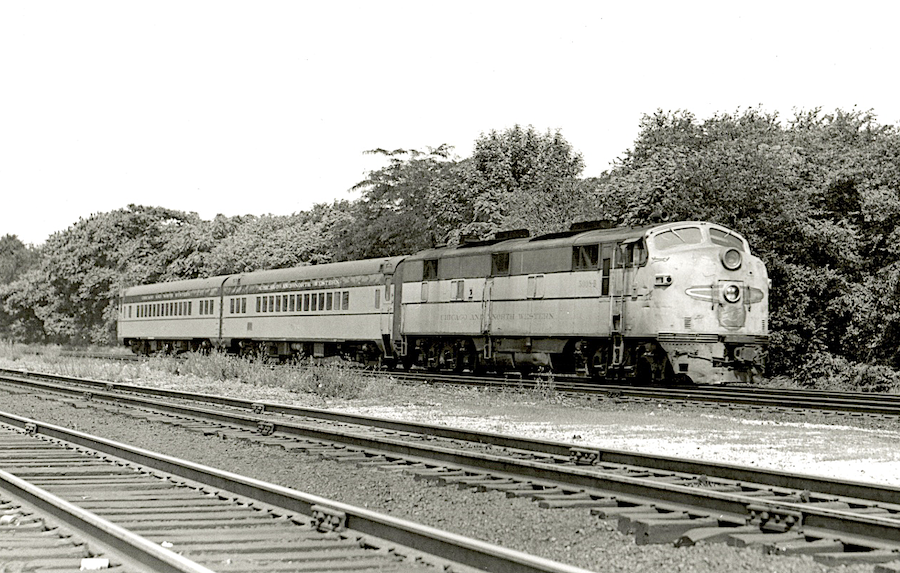
C&NW E7 5008B Kate Shelley 400" - EB Waller Avenue, Chicago - June 22, 1958 - AW Johnson Photo
The loss of the UP "Cities" trains on its Chicago-Omaha corridor, meant that C&NW had an opportunity to expedite its freight service and to restructure the passenger schedules on this corridor. That transition gave birth to the last of the "400: fleet, the "Kate Shelley 400." Initially running between Boone and Chicago, the train was trimmed back to a Cedar Rapids-Chicago run from August 1956. In October 1957, the train was further reduced to a Clinton-Chicago schedule. Dining car and parlor car accommodations came off with this final truncation. A pair of the 1946 Pullman-Standard-built coaches trail the 5008B (itself a graduate of EMD in August 1946), as the "Kate" approaches Central Avenue in Chicago's Austin neighborhood. The C&NW's passenger deficit in 1957 amounted to $19.6 million and was just one of many challenges the new C&NW management (led by Ben Heineman) was having to face head-on. The financial situation led the road to consider some innovative approaches. For example, during 1958, the Northwestern would sell 50 of its Pullman-Standard-built coaches to Hyman-Michaels, which would then contract for rebuild of the cars by Pullman-Standard, as well as lease the cars back to the C&NW for a 6-year term. The "Kate" would survive until the start of Amtrak. |
|
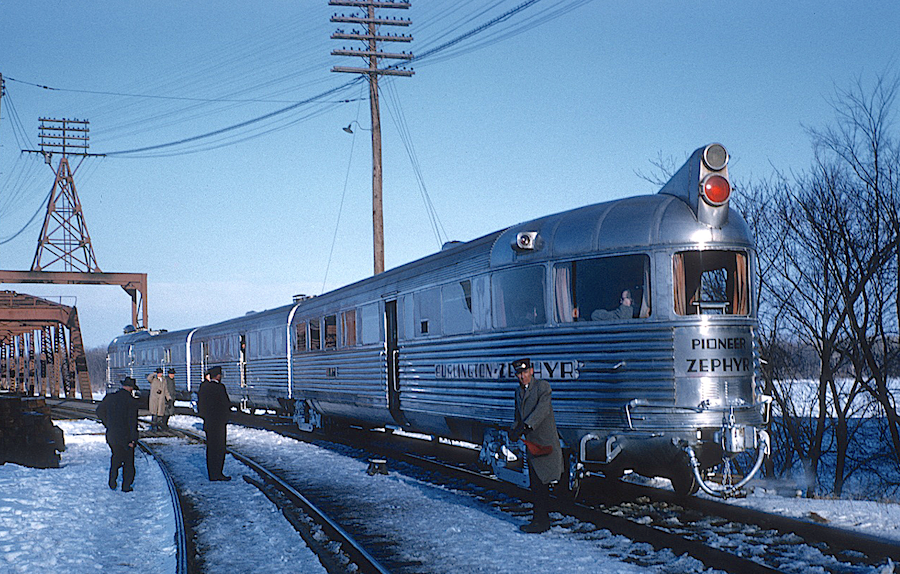
CB&Q 9900 "Pioneer Zephyr" - EB Burlington, IA - March 20, 1960
A photo stop was scheduled on the approach to the Mississippi River bridge for this
most-successful of the pioneering streamline trains. The combination of visionary railroad
and supply industry personnel, willing to take the chance on applying the Winton 201A diesel
engine, along with the Budd stainless steel/shotwelding process would forever change the industry.
This trip commemorated the retirement of the trainset to Chicago's Museum of Science & Industry,
where it was displayed from May 26, 1960.
About nine months prior to this view, the "Pioneer Zephyr" (this train was not designated by
that name until November 11, 1936) had accumulated around 3.2 million train-miles. Its final
revenue assignment (from late 1957) had been the on Lincoln-St. Joseph run. In the mid-1950s,
the trainset had been operating between Galesburg and St. Joseph. Bouncing around on various
runs on the CB&Q network was familiar territory for this train. It began its operating career
on the Lincoln-Kansas City run from November 11, 1934 and moved to the: Advance Denver Zephyr"
assignment during 1936.
|
|
Acknowledgements: As noted in the introductory text, Bill Krattville's "Steam, Steel & Limiteds" was a valuable resource; as was Robert Reed"s "The Streamline Era."" Joe Welsh's books on the B&O, CB&Q, PRR and UP passenger trains were also of considerable use, as was Jim Scribbins's "The 400 Story." Back issues of "Trains" magazine and "2200S," as well as Lou Marre's "Rock Island Diesel Locomotives,"" along with numerous websites were also consulted.
|